Category: Past Performances

Detailed race histories, speed figures, pace data, and form insights to help you analyze horses, compare contenders, and make smarter handicapping decisions.

  • How The Track’s Playing: Racetype & Track Bias Stats

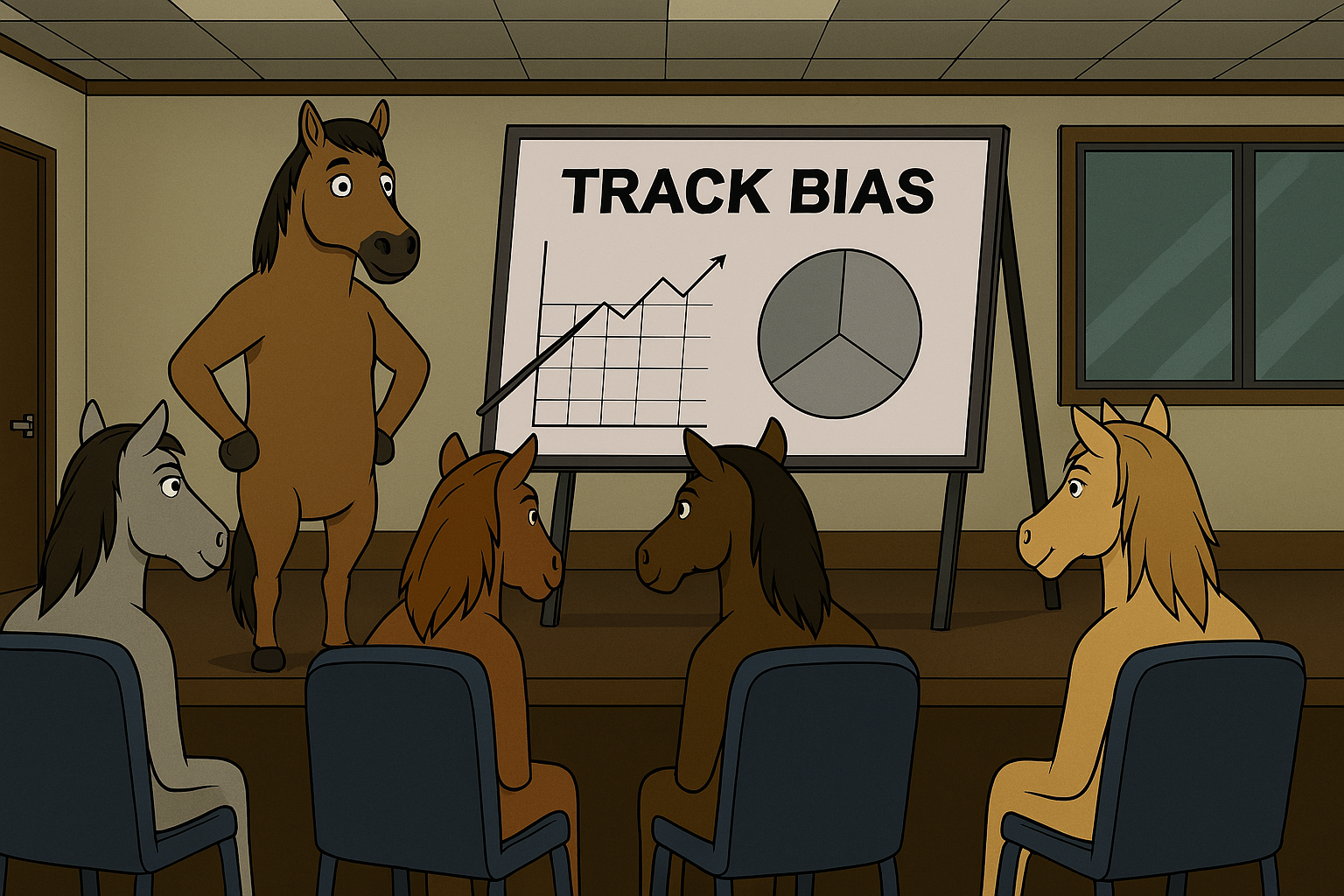
    How The Track’s Playing: Racetype & Track Bias Stats

    Racetype Stats and Track Bias Stats are two of the most valuable “context layers” in modern handicapping. They don’t describe the horses themselves—they describe the environment in which the horses must perform. When you understand these stats, you stop handicapping in isolation and start handicapping with a full picture of how the race is likely to unfold.

    📈 RaceType Stats: What They Are and Why They Matter

    RaceType Stats summarize how a specific type of race typically plays out at a given track. They are based on historical data for races with similar:

    • Class level
    • Distance
    • Surface
    • Age/sex restrictions

    These stats help you understand the profile of the race before you even look at the horses.

    What RaceType Stats Usually Include

    1. Win % by Running Style

    Shows how often each style wins:

    • E (Early)
    • E/P (Early/Presser)
    • P (Presser)
    • S (Sustained/Closer)

    Why it matters

    This tells you the typical winning blueprint for this race type.

    Examples:

    • If E horses win 40% of these races → early speed is a major advantage.
    • If S horses win only 5% → closers are up against it.

    2. Average Winning Speed Figure

    The typical speed figure required to win this race type.

    Why it matters

    This is a class benchmark.

    • Horses who have run above this figure are proven at the level.
    • Horses who have never approached it are class‑challenged.

    3. Average Field Size

    Larger fields = more chaos Smaller fields = pace advantage for speed

    Why it matters

    Field size influences:

    • Trip trouble
    • Pace pressure
    • Exotic payouts

    4. Favorite Win %

    Shows how often favorites win this race type.

    Why it matters

    • High favorite win % → chalky race type
    • Low favorite win % → good for longshot hunting

    5. ROI (Return on Investment)

    Shows profitability of betting certain categories (favorites, longshots, running styles).

    Why it matters

    ROI reveals where the public misjudges races.

    Example:

    • If E/P horses show a positive ROI → public undervalues tactical speed.
    • If favorites show a negative ROI → race type is chaotic.

    🧠 How to Use RaceType Stats in Handicapping

    1. Build a Pace Model

    If the race type favors early speed, you upgrade:

    • Lone speed
    • Horses with high E1/E2 figures
    • Horses with inside posts

    If the race type favors closers, you upgrade:

    • High LP horses
    • Horses with strong late kick
    • Horses exiting fast‑paced races

    2. Evaluate Class Fit

    Compare each horse’s best speed figure to the RaceType par.

    • Above par → strong contender
    • At par → competitive
    • Below par → needs improvement

    3. Identify Vulnerable Favorites

    If favorites win only 25% of this race type, a 6/5 favorite is a prime bet‑against.

    4. Spot Live Longshots

    If longshots historically perform well in this race type, you can confidently include them in exotics.

    🏟️ Track Bias Stats: What They Are and Why They Matter

    Track Bias Stats describe how the track surface itself has been playing recently or historically. These stats are based on:

    • Running style
    • Post position
    • Path (inside vs. outside)
    • Early speed vs. late kick

    Track biases can be temporary (weather‑related) or structural (track design).

    What Track Bias Stats Usually Include

    1. Running Style Bias

    Shows which styles are winning:

    • Speed bias
    • Stalker bias
    • Closer bias

    Why it matters

    If the track is favoring speed, closers must be downgraded—even if they look good on paper.

    2. Post Position Bias

    Shows which posts win more often.

    Why it matters

    • Inside posts may dominate in sprints.
    • Outside posts may dominate in turf routes.
    • Certain posts may be death traps on wet tracks.

    3. Path Bias (Inside/Outside)

    Shows whether the rail is:

    • Dead
    • Neutral
    • Golden

    Why it matters

    A horse stuck on a dead rail last time may be better than the running line suggests.

    4. Early Speed %

    Shows how often wire‑to‑wire winners occur.

    Why it matters

    High wire‑to‑wire % → upgrade lone speed Low wire‑to‑wire % → downgrade need‑the‑lead types

    5. Surface‑Specific Bias

    Dirt, turf, and synthetic each have unique tendencies.

    Examples:

    • Turf often favors closers
    • Dirt often favors early speed
    • Synthetic often favors mid‑pack runners

    🧠 How to Use Track Bias Stats in Handicapping

    1. Upgrade Horses Who Fit the Bias

    If the track favors early speed:

    • Upgrade E and E/P horses
    • Downgrade deep closers

    If the rail is golden:

    • Upgrade inside posts
    • Downgrade wide runners

    2. Identify “Bias Victims”

    Horses who ran against the bias last time out are often:

    • Better than they look
    • Underbet
    • Great value plays

    Example:

    • A closer finishing 5th on a strong speed‑bias day may be sitting on a big effort.

    3. Identify “Bias Beneficiaries”

    Horses who ran well because of a bias may be:

    • Overbet
    • Vulnerable favorites

    Example:

    • A horse who wired the field on a golden‑rail day may regress today.

    4. Build More Accurate Pace Scenarios

    Track bias + pace = powerful combination.

    If the track favors closers and the race has multiple speed horses → meltdown likely.

    If the track favors speed and there is only one E horse → lone‑speed threat.

    🏁 Why Racetype Stats + Track Bias Stats Are So Powerful Together

    When combined, they give you:

    • The typical profile of the race (RaceType Stats)
    • The current behavior of the surface (Track Bias Stats)
    • The likely pace scenario
    • The horses who fit today’s conditions
    • The horses who are mis‑spotted
    • The horses who will be overbet or underbet

    This is how professional handicappers find:

    • Live longshots
    • Vulnerable favorites
    • Strong singles in multi‑race wagers
    • Horses ready to improve

    Do you use Racetype Stats & Track Bias Stats in you handicapping? How so? Feel free to comment below.

  • Workouts: Getting in Race Shape

    Workouts: Getting in Race Shape

    The workouts section of a past performance is one of the most revealing—and misunderstood—parts of handicapping. While speed figures and class levels tell you what a horse has done, workouts help you understand what a horse is ready to do today. They offer a window into fitness, form cycles, trainer intent, and even hidden improvements that don’t show up in race lines.

    🏋️ What the Workouts Section Shows

    Each workout line typically includes:

    • Date
    • Track abbreviation
    • Distance (in furlongs)
    • Surface condition (ft, gd, wf, sy, etc.)
    • Time (raw clocking)
    • Breezing/Handily indicator (B or H)
    • Rank among workers that day (e.g., 5/43)

    Let’s break down each component and its handicapping significance.

    📅 1. Date of the Workout

    What it tells you

    • How recently the horse has trained
    • Whether the horse is maintaining a steady schedule
    • Whether the horse is coming off a layoff
    • Whether the horse is being sharpened or slowed down

    Handicapping significance

    • Recent workouts (within 7–14 days) indicate readiness.
    • Long gaps may signal:
      • Minor physical issues
      • Trainer caution
      • A horse not fully cranked
    • A pattern of consistent weekly works is ideal.
    • A sudden burst of activity after inactivity can signal a horse coming into form.

    🏟️ 2. Track Abbreviation

    What it tells you

    Where the workout occurred.

    Handicapping significance

    • Horses working at the race‑day track often perform better.
    • Shipping horses may need time to acclimate.
    • Some tracks have faster or slower surfaces, affecting times.

    Example tendencies:

    • California tracks often produce fast times.
    • Some winter tracks produce slower works due to weather.

    📏 3. Distance of the Workout

    Workouts are measured in furlongs (1 furlong = 1/8 mile).

    Common distances

    • 3f – speed sharpening
    • 4f – standard maintenance work
    • 5f–6f – stamina building
    • 7f+ – serious conditioning (rare)

    Handicapping significance

    • Short works (3f–4f) sharpen speed.
    • Longer works (5f–6f) indicate fitness and stamina.
    • A mix of short and long works is ideal for horses stretching out.
    • Multiple 5f+ works often signal a horse is fully cranked for a peak effort.

    🌦️ 4. Track Condition (ft, gd, wf, sy)

    What it tells you

    The surface condition during the workout.

    Handicapping significance

    • Fast (ft) is the standard baseline.
    • Good/wet‑fast can produce misleadingly slow or fast times.
    • Synthetic surfaces often produce slower times but better stamina.
    • Turf works are rare and usually signal turf intent.

    ⏱️ 5. Workout Time

    What it tells you

    The raw time for the distance (e.g., :48 for 4f).

    Handicapping significance

    Workout times must be interpreted in context:

    • A :47 at a slow track may be excellent.
    • A :47 at a fast track may be average.
    • A slow time can still be good if the horse was not asked.
    • A fast time can be meaningless if the horse was pushed hard.

    Never evaluate workout times in isolation.

    🏃 6. Breezing (B) vs. Handily (H)

    What it tells you

    • Breezing (B): Horse worked easily without urging.
    • Handily (H): Horse was asked for effort.

    Handicapping significance

    • Breezing works suggest natural fitness and talent.
    • Handily works suggest intentional sharpening or conditioning.
    • A horse switching from H → B may be peaking.
    • A horse switching from B → H may need conditioning.

    📊 7. Rank Among Workers (e.g., 5/43)

    What it tells you

    How the horse’s time compared to others at the same distance that day.

    Handicapping significance

    This is often more important than the raw time.

    • 1/50 → fastest of 50 workers; excellent sign.
    • 5/50 → very good.
    • 25/50 → average.
    • 50/50 → slowest; may indicate lack of fitness.

    However, context matters:

    • If only a few horses worked that day, rankings are less meaningful.
    • Some trainers never push horses in the morning.

    🧠 How Workouts Influence Handicapping

    Workouts help you evaluate:

    🟦 1. Fitness

    A horse with:

    • Multiple 5f works
    • Consistent weekly activity
    • Sharp recent times

    …is likely fit and ready.

    A horse with:

    • Sparse works
    • Long gaps
    • Slow times

    …may need a race.

    🟩 2. Form Cycle

    Workouts reveal whether a horse is:

    • Improving
    • Declining
    • Maintaining form
    • Coming off a layoff
    • Being prepared for a peak effort

    Patterns matter more than individual works.

    🟧 3. Trainer Intent

    Some trainers use workouts to signal intent:

    • Fast works → horse is cranked
    • Slow, steady works → horse is being conditioned
    • Bullet works → horse is sharp and ready
    • Workouts immediately after a race → horse came out of the race well

    Trainer patterns are extremely important.

    🟥 4. Surface or Distance Changes

    Workouts can hint at:

    • A horse preparing for turf (turf works)
    • A horse preparing for a route (longer works)
    • A horse preparing for a sprint (short, sharp works)

    🟪 5. Layoff Horses

    Workouts are crucial for horses returning from:

    • 60+ day layoffs
    • Seasonal breaks
    • Injuries

    Key signs of readiness:

    • Multiple 5f+ works
    • A recent sharp work
    • A steady pattern with no gaps

    🟫 6. First‑Time Starters

    Workouts are the only data available.

    Look for:

    • Multiple 5f works
    • A bullet or near‑bullet
    • Strong trainer stats with debut runners
    • Gate works (indicated in some PP formats)

    🏁 Putting It All Together

    The workouts section helps you answer:

    • Is the horse fit?
    • Is the horse improving?
    • Is the trainer signaling intent?
    • Is the horse ready off a layoff?
    • Is the horse being sharpened or conditioned?
    • Does the workout pattern match today’s race?

    Workouts don’t replace past‑performance lines—but they complete the picture.

  • Been There Done That: Analyzing Previous Races

    Been There Done That: Analyzing Previous Races

    The previous race section—the long horizontal lines of data showing each horse’s past performances—is the engine room of handicapping. Everything you need to understand a horse’s form, class, pace, trip, and suitability for today’s race is encoded in these lines. Once you know how to read them, you can interpret a horse’s entire career at a glance.

    📅 1. DATE & TRACK (DATE / TRK)

    What it shows

    • The date of the race
    • The track abbreviation (e.g., FG, CD, SAR, DMR)

    Why it matters

    • Recency: Recent races are more predictive.
    • Track quality: Some circuits are stronger than others.
    • Track configuration: Tight turns, long stretches, and altitude all matter.
    • Shipping: Horses shipping long distances may need adjustment.

    📏 2. DISTANCE & SURFACE

    What it shows

    • Distance (e.g., 6f, 1m, 1 1/16m)
    • Surface (dirt, turf, synthetic)
    • Track condition (ft, fm, sy, my, yl, gd)

    Why it matters

    • Horses have preferred distances and surfaces.
    • Off‑track conditions can dramatically change performance.
    • Distance/surface changes often signal trainer intent.

    ⏱️ 3. Fractional Times ( :22, :46, 1:11, etc.)

    What it shows

    The internal splits of the race.

    Why it matters

    • Fast fractions → pace meltdown → closers benefit
    • Slow fractions → speed holds
    • Helps identify whether a horse was chasing a hot pace or sitting behind a slow one

    Fractional times are essential for pace handicapping.

    📊 4. RR (Race Rating)

    What it shows

    A Brisnet figure representing the overall strength of the race.

    Why it matters

    • Higher RR = tougher race
    • Helps compare races across tracks
    • Useful for evaluating class moves

    A horse exiting a high‑RR race is often facing easier competition today.

    🏆 5. RACETYPE

    What it shows

    The classification of the race:

    • Maiden
    • Claiming
    • Allowance
    • Optional claiming
    • Stakes
    • Graded stakes

    Why it matters

    Race type is the purest indicator of class.

    A horse dropping from stakes to allowance—or allowance to claiming—is often dangerous.

    📈 6. CR (Class Rating)

    What it shows

    A Brisnet figure measuring the class level of the race.

    Why it matters

    • Higher CR = stronger competition
    • Helps identify class drops and rises
    • Useful for spotting “class monsters” who consistently outrun the level

    🏇 7. Pace Figures (E1, E2, LP)

    What they show

    • E1: Early pace (first call)
    • E2: Mid‑pace (second call)
    • LP: Late pace (final fraction)

    Why they matter

    These figures reveal:

    • Running style
    • Whether the horse is improving or declining
    • Suitability for today’s pace scenario

    Examples:

    • High E1/E2 → early speed threat
    • High LP → dangerous closer
    • Balanced figures → tactical horse

    📍 8. 1C / 2C (Beaten Lengths at Calls)

    What it shows

    How many lengths the horse was ahead or behind at:

    • First call
    • Second call

    Why it matters

    • Shows whether the horse was involved in the pace
    • Helps identify hidden moves
    • Reveals whether the horse was gaining or fading

    A horse who was +10 lengths back early but only +2 late is improving.

    🏃‍➡️ 9. SPD (Speed Figure)

    What it shows

    The final Brisnet speed figure for the race.

    Why it matters

    Speed figures are the most widely used handicapping tool.

    • High figure → strong performance
    • Repeated high figures → consistency
    • Big jump → improvement
    • Big drop → regression or trouble

    Comparing speed figures to pars is especially powerful.

    🎽 10. PP (Post Position)

    What it shows

    The horse’s starting gate position.

    Why it matters

    • Inside posts help in sprints
    • Outside posts help in turf routes
    • Bad posts can excuse poor performances

    🚦 11. ST (Start)

    What it shows

    How the horse broke from the gate.

    Examples:

    • “1” = broke first
    • “9” = broke last

    Why it matters

    Bad starts can ruin races, especially for speed horses.

    📉 12. Running Positions (1C, 2C, STR, FIN)

    What it shows

    The horse’s position at:

    • First call
    • Second call
    • Stretch
    • Finish

    Why it matters

    This is the story of the race.

    You can see:

    • Whether the horse made a move
    • Whether it faded
    • Whether it was wide or inside
    • Whether it was involved in a duel

    These patterns reveal form cycles and running style tendencies.

    🧑‍🏇 13. Jockey

    What it shows

    The rider for that race.

    Why it matters

    • Jockey changes can signal intent
    • Some jockeys excel with certain running styles
    • A top jockey replacing a low‑percentage rider is a major angle

    💊 14. Medication and Equipment

    What it shows

    • L = Lasix
    • b = blinkers
    • Lb = Lasix + blinkers

    Why it matters

    Medication and equipment changes can produce:

    • Improved early speed
    • Better focus
    • Better stamina
    • Rebounds after poor races

    Blinkers on/off is one of the most powerful trainer moves.

    💵 15. ODDS

    What it shows

    The horse’s final betting odds.

    Why it matters

    Odds reveal public perception.

    • Low odds → expected strong performance
    • High odds → poor public confidence
    • A horse who ran well at long odds may be improving

    🏆 16. Top Finishers

    What it shows

    The winner and key rivals.

    Why it matters

    • Helps evaluate the quality of the field
    • Shows whether the horse faced future winners
    • Useful for class comparisons

    📝 17. Comments (Trip Notes)

    What it shows

    A brief description of the horse’s trip.

    Examples:

    • “3‑wide bid”
    • “Steadied early”
    • “Blocked in stretch”
    • “Duel; tired late”

    Why it matters

    Trip notes are gold.

    They reveal:

    • Hidden trouble
    • Excusable losses
    • Strong efforts masked by bad trips
    • Horses ready to improve

    Trip handicapping is one of the biggest edges in racing.

    🧮 18. Field Size

    What it shows

    The number of runners in the race.

    Why it matters

    • Large fields = more traffic, more chaos
    • Small fields = pace advantage for speed

    A horse finishing 4th in a 12‑horse field may have run better than a horse finishing 2nd in a 4‑horse field.

    🧠 How the Previous Race Section Influences Handicapping

    These lines help you determine:

    1. Form

    Is the horse improving, declining, or cycling up?

    2. Class

    Has the horse been facing tougher or weaker fields?

    3. Pace

    Does the horse fit today’s pace scenario?

    4. Trip

    Was the last race better or worse than it looks?

    5. Suitability

    Does the horse want today’s distance, surface, and conditions?

    6. Intent

    Do trainer patterns suggest today is a “go” race?

    7. Value

    Is the horse likely to be overbet or underbet?

    What are some of your points of focus when analyzing a horse’s previous races? Are you focused on speed, pace, surface, or distance? Jump in the conversation and let us know.

  • The Horse’s 411 in Past Performances

    The Horse’s 411 in Past Performances

    The header section for each horse in a past performance is deceptively dense. It looks simple at first glance—just a few lines of text above the past‑performance lines—but it actually contains some of the most important handicapping information in the entire sheet. This is where you learn who the horse is, how they typically run, what their strengths and weaknesses are, and how they fit today’s race.

    🏇 1. Horse Name & Running Style

    What it is

    • The horse’s registered name
    • A running‑style designation such as:
      • E – Early (front‑runner)
      • E/P – Early/Presser
      • P – Presser
      • S – Sustained/Closer
    • A numerical “run style point” score (0–8)

    Why it matters

    Running style is the foundation of pace handicapping.

    • E horses want the lead and can wire the field if unchallenged.
    • E/P horses sit just off the pace and get ideal trips.
    • P horses stalk and pounce.
    • S horses rely on pace meltdowns.

    The point score shows how strongly the horse fits that style. An E 8 is a true speed horse; an E 2 is more flexible.

    🧬 2. Color, Sex, and Age

    What it is

    • Color (chestnut, bay, gray, etc.)
    • Sex (f = filly, m = mare, c = colt, g = gelding, h = horse)
    • Age (2–10+)

    Why it matters

    Age and sex influence:

    • Physical maturity
    • Form cycles
    • Race placement
    • Eligibility for conditions

    For example:

    • 3‑year‑olds often improve rapidly.
    • Older mares may tail off seasonally.
    • Geldings tend to be more consistent.

    🏦 3. Purchase Price or Sale Information

    What it is

    Auction price and sale year (if applicable).

    Why it matters

    Purchase price is a class indicator.

    • High‑priced horses often debut in MSW or stakes.
    • Low‑priced horses may be spotted in claiming races.
    • A big purchase price drop into claiming can signal trainer intent or physical issues.

    📈 4. Prime Power Rating

    What it is

    A proprietary Brisnet composite rating combining:

    • Speed
    • Class
    • Pace
    • Consistency
    • Recent form

    Why it matters

    Prime Power is one of the most predictive single numbers in handicapping.

    • Horses ranked 1st or 2nd win a large percentage of races.
    • A big gap between the top horse and the field is meaningful.
    • Low Prime Power horses must improve dramatically to compete.

    📊 5. Lifetime Record & Earnings

    What it is

    A summary of:

    • Total starts
    • Wins, places, shows
    • Total earnings
    • Best speed figure

    Often broken down by:

    • Year
    • Surface (FST, OFF, TRF, AW)
    • Distance category

    Why it matters

    This section reveals:

    • Consistency
    • Surface preference
    • Distance suitability
    • Class level (earnings per start)
    • Form cycles

    A horse with:

    • 10 starts, 0 wins → may lack finishing ability
    • Big turf earnings → turf specialist
    • High earnings per start → class horse

    🧑‍🏫 6. Owner, Trainer, and Jockey

    What it is

    • Owner name
    • Trainer name
    • Jockey name
    • Win %, in‑the‑money %, and ROI for each
    • Specialty stats (routes, sprints, layoff, turf‑to‑dirt, etc.)

    Why it matters

    Connections are one of the strongest predictors of performance.

    • High‑percentage trainers win more often.
    • Certain jockeys excel with certain running styles.
    • Trainer/jockey combinations with strong stats are dangerous.
    • Layoff stats reveal whether a trainer fires fresh or needs a race.

    🧬 7. Sire, Dam, and Breeder Information

    What it is

    • Sire and dam names
    • Sire’s stud fee
    • Breeder name
    • Sire and dam‑sire statistics:
      • Average winning distance (AWD)
      • Mud %, turf %, synthetic %
      • SPI (Sire Performance Index)

    Why it matters

    Pedigree is crucial for:

    • Surface switches
    • Distance changes
    • Off‑track conditions
    • Turf aptitude
    • Late‑developing vs. early‑developing horses

    A sire with high mud or turf percentages is a major angle.

    📝 8. QuickPlay or Handicapping Comments

    What it is

    Short notes summarizing:

    • Strengths
    • Weaknesses
    • Angles
    • Trainer patterns
    • Running style advantages
    • Recent form

    Why it matters

    These comments highlight:

    • Key handicapping angles
    • Reasons for improvement
    • Reasons for regression
    • Biases or pace setups

    They’re especially useful for beginners but still valuable for experienced handicappers.

    🧮 9. Track‑Specific Stats

    Often includes:

    • Starts at today’s track
    • Earnings at today’s track
    • Best speed figure at today’s track
    • Trainer/jockey stats at this track

    Why it matters

    Some horses:

    • Love certain tracks (“horses for courses”)
    • Hate tight turns or long stretches
    • Perform better at home tracks

    Track affinity is a real and powerful angle.

    🧩 10. Surface & Distance Records

    Breakdowns for:

    • Fast dirt
    • Off tracks
    • Turf
    • Synthetic
    • Distance category (sprints/routes)

    Why it matters

    This section tells you:

    • Whether the horse is properly placed
    • Whether today’s conditions are ideal
    • Whether a surface switch is likely to help or hurt

    A horse with:

    • 0‑for‑8 on turf
    • 3‑for‑5 on dirt

    …is telling you exactly where it wants to run.

    🏁 Why the Header Matters So Much

    The header is the identity card of the horse. It tells you:

    • Who the horse is
    • How they run
    • What they prefer
    • How they fit today’s race
    • Whether they’re improving or declining
    • Whether the connections are dangerous
    • Whether the pedigree matches today’s conditions

    Before you even look at the past‑performance lines, the header gives you a complete profile of the horse’s ability, tendencies, and suitability for today’s race.

  • Pars For The Course: How the Race SHOULD Run

    Pars For The Course: How the Race SHOULD Run

    Pars are one of the most powerful—but often overlooked—tools in a past performance. They act as a baseline, a context setter, and a class benchmark that helps you understand what kind of performance is typically required to win a race at today’s level. When you know how to use pars correctly, you stop handicapping in a vacuum and start handicapping with a calibrated measuring stick.

    🧭 What Are Pars?

    A par is a statistical average of winning performances for a specific race type at a specific track. Pars are usually calculated for:

    • Speed (final time figure)
    • E1 (early pace)
    • E2 (mid‑pace)
    • Late Pace
    • Class Rating

    In other words, pars tell you:

    “This is the level of performance typically needed to win this kind of race.”

    They are not predictions—they are benchmarks.

    🧩 Why Pars Exist

    Tracks run the same race types repeatedly:

    • Maiden Special Weight
    • Claiming $10k
    • Allowance n1x
    • Stakes
    • Turf sprints
    • Dirt routes

    Over time, these races produce consistent patterns in:

    • Winning speed figures
    • Early pace pressure
    • Late pace requirements
    • Class levels

    Pars summarize those patterns into a single, easy‑to‑read set of numbers.

    📊 What Pars Tell You

    Pars help you answer three critical handicapping questions:

    1. Is today’s race fast or slow for the level?

    If the par speed figure is 88, and most horses in the field run 80–82, the race is tougher than it looks.

    2. Which horses have already run at or above par?

    These horses are proven at the level.

    3. Which horses need to improve to be competitive?

    These horses are up against it unless they show a major jump.

    🧠 How Pars Improve Handicapping

    Pars give you a framework for evaluating:

    • Class moves
    • Surface switches
    • Distance changes
    • Form cycles
    • Pace scenarios

    Let’s break down how.

    🏇 1. Class Evaluation Using Pars

    Class is one of the hardest things to judge because race names can be misleading.

    Example:

    • A $50k claiming race at a small track may be weaker than a $25k claimer at a major track.
    • An allowance race at one track may be equivalent to a claiming race at another.

    Pars cut through the confusion.

    If a horse has run above par at a lower level → strong class riser.

    If a horse has never approached par → weak for the level.

    This is one of the most reliable ways to spot:

    • Live longshots
    • False favorites
    • Dangerous class droppers

    🏁 2. Pace Analysis Using Pars

    Pars include:

    • E1 (first call pace)
    • E2 (second call pace)
    • Late Pace

    These help you understand:

    How fast the early pace is expected to be.

    What kind of horse typically wins this race type.

    For example:

    • High E1/E2 pars → early speed is usually required
    • High Late Pace pars → closers often win
    • Balanced pars → tactical horses thrive

    This helps you build pace scenarios with more accuracy.

    🔄 3. Form Cycle Interpretation

    Pars help you judge whether a horse is:

    • Improving
    • Regressing
    • Stagnant
    • Peaking

    If a horse recently ran near par → form is sharp.

    If a horse ran far below par → form may be declining.

    This is especially useful for:

    • Layoff horses
    • 3‑year‑olds turning 4
    • Horses switching barns
    • Horses changing surfaces

    🧩 4. Identifying “Par Horses”

    A “par horse” is one that consistently runs:

    • At or slightly above par
    • Against similar competition
    • With reliable pace figures

    These horses are:

    • Extremely dangerous
    • Often overlooked
    • Great keys in vertical and horizontal wagers

    🎯 5. Spotting Vulnerable Favorites

    Favorites who never run near par are some of the best bets-against in racing.

    For example:

    • A horse with an 82 top figure
    • In a race with a par of 90

    …is almost always an underlay.

    Pars expose these situations instantly.

    🧩 6. Using Pars for Distance & Surface Changes

    Pars differ by:

    • Distance
    • Surface
    • Track
    • Class level

    This helps you evaluate:

    Is the new distance easier or harder?

    Is the new surface more demanding?

    Does the horse’s running style fit the par profile?

    Example:

    • Turf routes often have high Late Pace pars
    • Dirt sprints often have high E1/E2 pars

    A horse switching surfaces must match the par profile to be competitive.

    🏆 7. How Professional Handicappers Use Pars

    Pros use pars to:

    • Build pace models
    • Compare races across tracks
    • Identify class mismatches
    • Spot improving horses
    • Structure exotic tickets
    • Find overlays

    Pars are especially powerful in:

    • Allowance races
    • Optional claiming races
    • Turf routes
    • Maiden races with lightly raced horses

    Because these races often lack obvious form clues.

    🧩 8. Pars vs. Speed Figures

    Pars are not speed figures.

    Speed figures measure what a horse ran.

    Pars measure what the race typically requires.

    The magic happens when you compare the two.

    🏁 Final Thoughts: Why Pars Matter

    Pars give you:

    • A class benchmark
    • A pace benchmark
    • A performance benchmark
    • A way to compare horses across circuits
    • A way to spot value
    • A way to avoid bad favorites

    They are one of the most objective tools in handicapping because they summarize thousands of races into a simple, actionable set of numbers.

  • Past Performances in Race Handicapping: A Complete Guide to Reading Brisnet Ultimate PPs

    Past Performances in Race Handicapping: A Complete Guide to Reading Brisnet Ultimate PPs

    Past Performances (PPs) are the backbone of modern horse race handicapping. They’re the closest thing bettors have to a horse’s résumé—an organized, data‑rich record of everything a horse has done on the racetrack. When you know how to read them, PPs reveal patterns, strengths, weaknesses, and hidden opportunities that casual bettors miss.

    Among all PP formats, Brisnet’s Ultimate Past Performances with QuickPlay Comments stand out for their depth, structure, and handicapping‑friendly metrics.This guide breaks down exactly what PPs are, where to get them, and how to read every major section.

    PPs allow handicappers to evaluate form cycles, pace scenarios, class levels, and suitability for today’s conditions.

    🏇 What Are Past Performances?

    A Past Performance is a detailed statistical history of a racehorse’s previous races. Each line represents one race and includes:

    • Race date and track
    • Distance and surface
    • Fractional times
    • Speed and pace figures
    • Running positions
    • Jockey, odds, and finish
    • Comments describing the trip

    PPs allow handicappers to evaluate form cycles, pace scenarios, class levels, and suitability for today’s conditions.

    📥 Where Do You Get Past Performances?

    Major sources include:

    • Brisnet.com – Ultimate PPs, Premium PPs, and data files
    • Equibase – Standardized PPs and charts
    • Daily Racing Form (DRF) – Formulator and Classic PPs
    • Track programs – Simplified versions for on‑track bettors

    For deep analysis, Brisnet Ultimate PPs w/ QuickPlay Comments are among the most comprehensive.

    🧭 How to Read Brisnet Ultimate PPs

    Brisnet organizes each race into structured sections. Let’s walk through them using your Fair Grounds example.

    🏁 1. Track & Race Information

    This appears at the top of the sheet and includes:

    Race Type & Conditions

    Race Type & Conditions form the foundation of every horse race. They determine who can enterhow strong the field will be, and what kind of performance is required to win. Understanding them is essential for handicapping because they reveal the true class level of the race and the intent behind each horse’s placement.

    Link: A Guide to Horse Racing Types and Conditions

    Distance & Surface

    Distance and surface are two of the most influential—and often underestimated—factors in handicapping. They shape pace, stamina demands, running‑style advantages, trainer intent, and even which horses are eligible for certain conditions. When you understand how distance and surface interact, you start seeing races the way trainers and racing secretaries do.

    Link: Distance & Surface: The Architecture of How a Race Will Be Run

    Purse

    Link: Show Me The Money: A Guide to Purses in Horse Racing

    Bet Types

    Modern horse racing offers a wide range of bet types, from simple “pick the winner” wagers to complex multi‑race strategies that require deep handicapping skill. Each bet type rewards a different approach, and the most successful bettors tailor their strategy to the structure of the wager.

    Link: Wanna Bet? Wagering Choices in Horse Racing

    Pars

    Pars are one of the most powerful—but often overlooked—tools in a past performance. They act as a baseline, a context setter, and a class benchmark that helps you understand what kind of performance is typically required to win a race at today’s level. When you know how to use pars correctly, you stop handicapping in a vacuum and start handicapping with a calibrated measuring stick.

    Link: Pars For The Course

    🐎 2. Individual Entries

    Each horse gets a detailed block of information. Here’s how to read it.

    A. Horse Information

    Includes:

    • Name
    • Running Style (E, E/P, P, S)
      • E = Early (front‑runner)
      • E/P = Early/Presser
      • P = Presser
      • S = Sustained (closer)
    • Run Style Points (0–8)
    • Color, sex, age
    • Purchase price (if applicable)
    • Prime Power rating
    • Lifetime record
    • Earnings
    • Best speed figures by surface (FST, OFF, DIS, TRF, AW)

    The header section for each horse in a past performance is deceptively dense. It looks simple at first glance—just a few lines of text above the past‑performance lines—but it actually contains some of the most important handicapping information in the entire sheet. This is where you learn who the horse is, how they typically run, what their strengths and weaknesses are, and how they fit today’s race.

    Link: The Horse’s 411

    B. Ownership, Pedigree & Breeding

    Includes:

    • Owner
    • Sire & Dam
    • Sire’s stud fee
    • Breeder
    • Sire stats (AWD, mud %, SPI)
    • Dam’s sire stats

    These help evaluate pedigree suitability for:

    • Distance
    • Surface
    • Muddy tracks
    • Class potential

    C. Jockey & Trainer Stats

    Brisnet breaks these down into:

    • Overall win %
    • In last 60 days
    • With this running style
    • With this trainer
    • In routes
    • Off layoffs
    • Turf‑to‑dirt or dirt‑to‑turf moves

    Example: Jockey with E‑types: 16% wins, +0.47 ROI

    These stats help identify positive or negative rider/trainer patterns.

    D. QuickPlay Comments

    Short, handicapping‑oriented notes such as:

    • “Figures to improve returning to dirt”
    • “Hot jockey last 7 days”
    • “Eligible to improve 3rd off layoff”

    These highlight angles that matter.

    📊 3. Past Performance Lines

    The previous race section—the long horizontal lines of data showing each horse’s past performances—is the engine room of handicapping. Everything you need to understand a horse’s form, class, pace, trip, and suitability for today’s race is encoded in these lines. Once you know how to read them, you can interpret a horse’s entire career at a glance.

    Key Columns Explained

    ColumnMeaning
    DATE / TRKWhen and where the race was run
    DIST / SURFACEDistance and surface (ft, fm, sf, my)
    RRRace Rating (strength of field)
    RACETYPEAllowance, stakes, maiden, claiming
    CRClass Rating
    E1 / E2 / LPPace figures (early, mid, late)
    1c / 2cBeaten lengths at first and second call
    SPDFinal speed figure
    PPPost position
    STStart position
    1C / 2C / STR / FINRunning positions
    JOCKEYRider
    MedicationL (Lasix), b (blinkers)
    ODDSFinal betting odds
    Top FinishersWinner and key rivals
    CommentsTrip notes (e.g., “3‑wide bid; outkicked”)
    Field sizeNumber of runners

    These lines allow you to evaluate:

    • Form cycles
    • Pace preferences
    • Class changes
    • Surface/distance suitability
    • Trouble trips
    • Improvement patterns

    Link: Been There Done That: Reading Previous Races

    🏋️ 4. Training (Workouts) Section

    The workouts section of a past performance is one of the most revealing—and misunderstood—parts of handicapping. While speed figures and class levels tell you what a horse has done, workouts help you understand what a horse is ready to do today. They offer a window into fitness, form cycles, trainer intent, and even hidden improvements that don’t show up in race lines. Each workout includes:

    • Date
    • Track
    • Distance
    • Surface condition
    • Time
    • Breezing/Handily (B/H)
    • Rank vs. others that day

    Example: 30Jan FG 5f ft 1:00.3 B (8/43)

    This tells you:

    • 5 furlongs
    • Fast track
    • Breezing
    • 8th fastest of 43 workers

    Link: Workouts: Getting in Race Shape

    📈 5. Racetype Stats & Track Bias Stats

    Racetype Stats and Track Bias Stats are two of the most valuable “context layers” in modern handicapping. They don’t describe the horses themselves—they describe the environment in which the horses must perform. When you understand these stats, you stop handicapping in isolation and start handicapping with a full picture of how the race is likely to unfold.

    Race Type Stats

    • Win %
    • Favorite ITM %
    • ROI
    • Median win payoff
    • Field size

    Track Bias Stats

    Breakdowns by:

    • Running style (E, E/P, P, S)
    • Post position
    • Wire‑to‑wire %
    • Impact values

    Link: Racetype Stats & Track Bias Stats

    🧮 6. Race Summary Metrics

    Brisnet compiles key handicapping numbers:

    • Speed Last Race
    • Back Speed
    • Current Class
    • Average Class Last 3
    • Prime Power
    • Early Pace Last Race
    • Late Pace Last Race

    These allow quick comparison across the field.

    Example:

    • Paris Lily tops Speed Last Race (95), Prime Power (132.2), and Class Rating (116.3).
    • Amalfi Drive leads Best Speed at Distance (90).
    • Amarth shows strong mid‑pace and competitive class.

    🏆 Final Thoughts: Why Past Performances Matter

    Past Performances are the most powerful handicapping tool available. When you understand:

    • Race conditions
    • Pace dynamics
    • Class levels
    • Form cycles
    • Pedigree
    • Track biases
    • Speed and pace figures

    …you gain a massive edge over casual bettors.

    Brisnet’s Ultimate PPs with QuickPlay Comments combine raw data with expert‑level insights, making them ideal for both beginners and advanced handicappers.

  • Top Handicapping Tools to Boost Your Betting Game

    Top Handicapping Tools to Boost Your Betting Game

    This paragraph serves as an introduction to your blog post. Begin by discussing the primary theme or topic that you plan to cover, ensuring it captures the reader’s interest from the very first sentence. Share a brief overview that highlights why this topic is important and how it can provide value. Use this space to set the tone for the rest of the article, preparing readers for the journey ahead. Keep your language approachable, yet informative, to create a strong connection.

    Sometimes, the simplest moments hold the deepest wisdom. Let your thoughts settle, and clarity will find you. Use this quote space to share something inspirational or reflective, perfectly aligned with the theme of your article.

    This paragraph dives deeper into the topic introduced earlier, expanding on the main idea with examples, analysis, or additional context. Use this section to elaborate on specific points, ensuring that each sentence builds on the last to maintain a cohesive flow. You can include data, anecdotes, or expert opinions to reinforce your claims. Keep your language concise but descriptive enough to keep readers engaged. This is where the substance of your article begins to take shape.

    As you move toward the midpoint of the article, this paragraph provides an opportunity to connect earlier ideas with new insights. Use this space to present alternative perspectives or address potential questions readers might have. Strike a balance between depth and readability, ensuring the information remains digestible. This section can also serve as a transition to the closing points, maintaining momentum as you steer the discussion to its final stages.

    Wrapping Up with Key Insights

    In this concluding paragraph, summarize the key takeaways from your article, reinforcing the most important ideas discussed. Encourage readers to reflect on the insights shared, or offer actionable advice they can apply in their own lives. This is your chance to leave a lasting impression, so make sure your closing thoughts are impactful and memorable. A strong conclusion not only ties the article together but also inspires readers to engage further.

  • The Evolution of Horse Racing: A Historical Overview

    The Evolution of Horse Racing: A Historical Overview

    This paragraph serves as an introduction to your blog post. Begin by discussing the primary theme or topic that you plan to cover, ensuring it captures the reader’s interest from the very first sentence. Share a brief overview that highlights why this topic is important and how it can provide value. Use this space to set the tone for the rest of the article, preparing readers for the journey ahead. Keep your language approachable, yet informative, to create a strong connection.

    Sometimes, the simplest moments hold the deepest wisdom. Let your thoughts settle, and clarity will find you. Use this quote space to share something inspirational or reflective, perfectly aligned with the theme of your article.

    This paragraph dives deeper into the topic introduced earlier, expanding on the main idea with examples, analysis, or additional context. Use this section to elaborate on specific points, ensuring that each sentence builds on the last to maintain a cohesive flow. You can include data, anecdotes, or expert opinions to reinforce your claims. Keep your language concise but descriptive enough to keep readers engaged. This is where the substance of your article begins to take shape.

    As you move toward the midpoint of the article, this paragraph provides an opportunity to connect earlier ideas with new insights. Use this space to present alternative perspectives or address potential questions readers might have. Strike a balance between depth and readability, ensuring the information remains digestible. This section can also serve as a transition to the closing points, maintaining momentum as you steer the discussion to its final stages.

    Wrapping Up with Key Insights

    In this concluding paragraph, summarize the key takeaways from your article, reinforcing the most important ideas discussed. Encourage readers to reflect on the insights shared, or offer actionable advice they can apply in their own lives. This is your chance to leave a lasting impression, so make sure your closing thoughts are impactful and memorable. A strong conclusion not only ties the article together but also inspires readers to engage further.