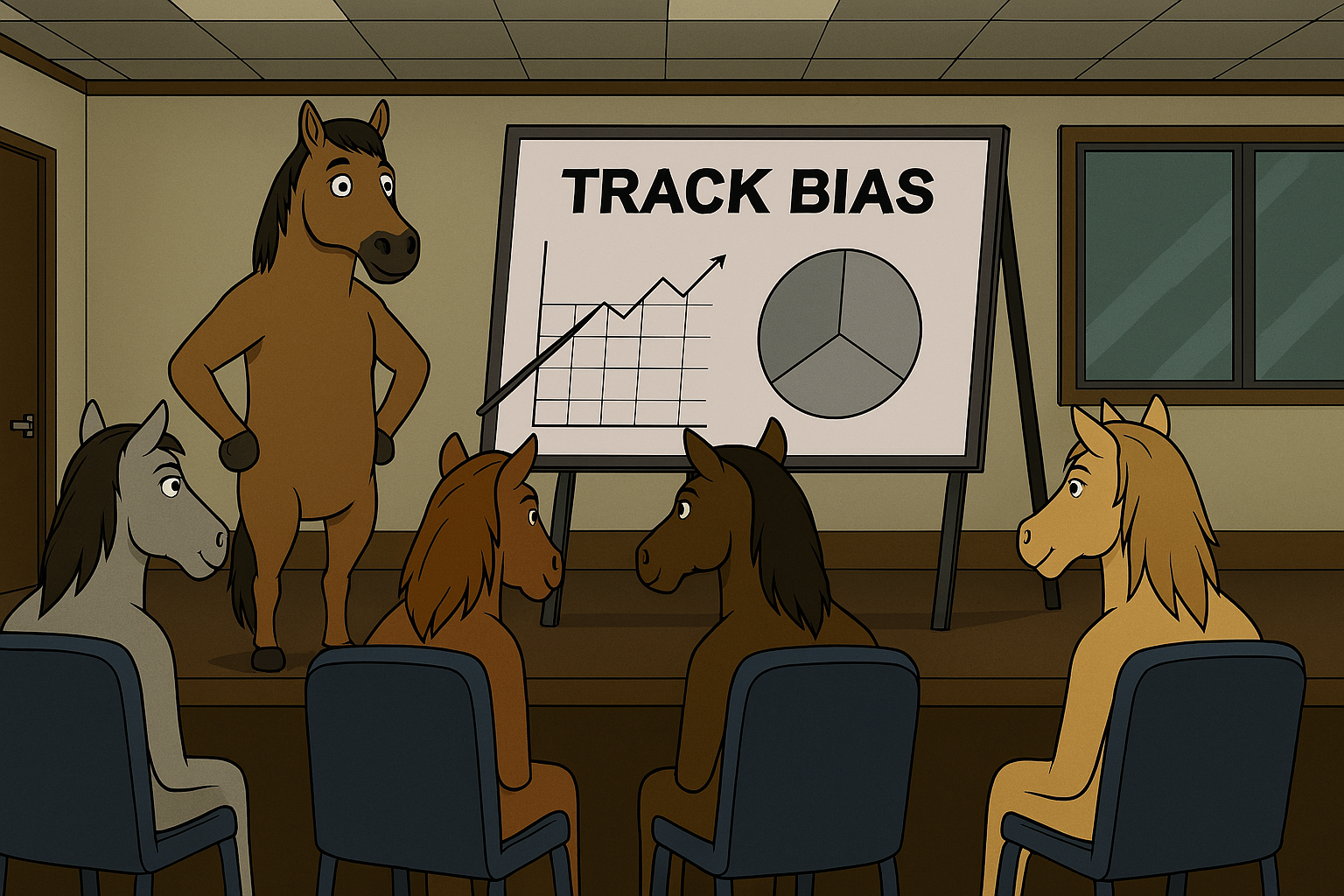
Racetype Stats and Track Bias Stats are two of the most valuable “context layers” in modern handicapping. They don’t describe the horses themselves—they describe the environment in which the horses must perform. When you understand these stats, you stop handicapping in isolation and start handicapping with a full picture of how the race is likely to unfold.
📈 RaceType Stats: What They Are and Why They Matter
RaceType Stats summarize how a specific type of race typically plays out at a given track. They are based on historical data for races with similar:
- Class level
- Distance
- Surface
- Age/sex restrictions
These stats help you understand the profile of the race before you even look at the horses.
What RaceType Stats Usually Include
1. Win % by Running Style
Shows how often each style wins:
- E (Early)
- E/P (Early/Presser)
- P (Presser)
- S (Sustained/Closer)
Why it matters
This tells you the typical winning blueprint for this race type.
Examples:
- If E horses win 40% of these races → early speed is a major advantage.
- If S horses win only 5% → closers are up against it.
2. Average Winning Speed Figure
The typical speed figure required to win this race type.
Why it matters
This is a class benchmark.
- Horses who have run above this figure are proven at the level.
- Horses who have never approached it are class‑challenged.
3. Average Field Size
Larger fields = more chaos Smaller fields = pace advantage for speed
Why it matters
Field size influences:
- Trip trouble
- Pace pressure
- Exotic payouts
4. Favorite Win %
Shows how often favorites win this race type.
Why it matters
- High favorite win % → chalky race type
- Low favorite win % → good for longshot hunting
5. ROI (Return on Investment)
Shows profitability of betting certain categories (favorites, longshots, running styles).
Why it matters
ROI reveals where the public misjudges races.
Example:
- If E/P horses show a positive ROI → public undervalues tactical speed.
- If favorites show a negative ROI → race type is chaotic.
🧠 How to Use RaceType Stats in Handicapping
1. Build a Pace Model
If the race type favors early speed, you upgrade:
- Lone speed
- Horses with high E1/E2 figures
- Horses with inside posts
If the race type favors closers, you upgrade:
- High LP horses
- Horses with strong late kick
- Horses exiting fast‑paced races
2. Evaluate Class Fit
Compare each horse’s best speed figure to the RaceType par.
- Above par → strong contender
- At par → competitive
- Below par → needs improvement
3. Identify Vulnerable Favorites
If favorites win only 25% of this race type, a 6/5 favorite is a prime bet‑against.
4. Spot Live Longshots
If longshots historically perform well in this race type, you can confidently include them in exotics.
🏟️ Track Bias Stats: What They Are and Why They Matter
Track Bias Stats describe how the track surface itself has been playing recently or historically. These stats are based on:
- Running style
- Post position
- Path (inside vs. outside)
- Early speed vs. late kick
Track biases can be temporary (weather‑related) or structural (track design).
What Track Bias Stats Usually Include
1. Running Style Bias
Shows which styles are winning:
- Speed bias
- Stalker bias
- Closer bias
Why it matters
If the track is favoring speed, closers must be downgraded—even if they look good on paper.
2. Post Position Bias
Shows which posts win more often.
Why it matters
- Inside posts may dominate in sprints.
- Outside posts may dominate in turf routes.
- Certain posts may be death traps on wet tracks.
3. Path Bias (Inside/Outside)
Shows whether the rail is:
- Dead
- Neutral
- Golden
Why it matters
A horse stuck on a dead rail last time may be better than the running line suggests.
4. Early Speed %
Shows how often wire‑to‑wire winners occur.
Why it matters
High wire‑to‑wire % → upgrade lone speed Low wire‑to‑wire % → downgrade need‑the‑lead types
5. Surface‑Specific Bias
Dirt, turf, and synthetic each have unique tendencies.
Examples:
- Turf often favors closers
- Dirt often favors early speed
- Synthetic often favors mid‑pack runners
🧠 How to Use Track Bias Stats in Handicapping
1. Upgrade Horses Who Fit the Bias
If the track favors early speed:
- Upgrade E and E/P horses
- Downgrade deep closers
If the rail is golden:
- Upgrade inside posts
- Downgrade wide runners
2. Identify “Bias Victims”
Horses who ran against the bias last time out are often:
- Better than they look
- Underbet
- Great value plays
Example:
- A closer finishing 5th on a strong speed‑bias day may be sitting on a big effort.
3. Identify “Bias Beneficiaries”
Horses who ran well because of a bias may be:
- Overbet
- Vulnerable favorites
Example:
- A horse who wired the field on a golden‑rail day may regress today.
4. Build More Accurate Pace Scenarios
Track bias + pace = powerful combination.
If the track favors closers and the race has multiple speed horses → meltdown likely.
If the track favors speed and there is only one E horse → lone‑speed threat.
🏁 Why Racetype Stats + Track Bias Stats Are So Powerful Together
When combined, they give you:
- The typical profile of the race (RaceType Stats)
- The current behavior of the surface (Track Bias Stats)
- The likely pace scenario
- The horses who fit today’s conditions
- The horses who are mis‑spotted
- The horses who will be overbet or underbet
This is how professional handicappers find:
- Live longshots
- Vulnerable favorites
- Strong singles in multi‑race wagers
- Horses ready to improve
Do you use Racetype Stats & Track Bias Stats in you handicapping? How so? Feel free to comment below.
Leave a Reply